

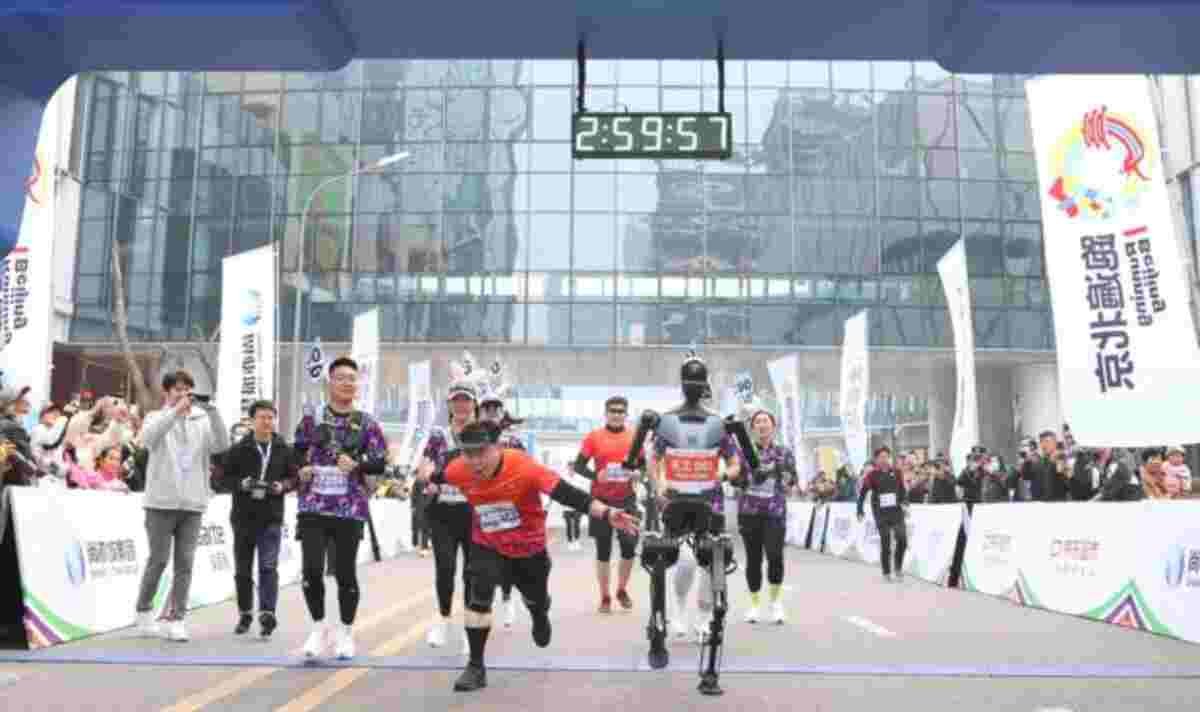
In one of the most shocking and futuristic moments of 2026, a humanoid robot has officially outperformed human athletes in a half marathon, marking a historic turning point in the evolution of robotics and artificial intelligence. The event took place at the Beijing E-Town Half Marathon, where robots and humans competed side by side in a groundbreaking race that stunned the world.
The star of the event was a humanoid robot developed by Chinese tech company Honor, which completed the 21.1-kilometer race in just 50 minutes and 26 seconds. This timing didn’t just win the race—it shattered the human world record of 57 minutes and 20 seconds, previously set by elite athlete Jacob Kiplimo. The achievement instantly went viral, sparking conversations about the future of sports, AI, and human limits.
What makes this accomplishment even more remarkable is the speed of progress. Just a year earlier, the fastest robot in a similar event took over 2 hours and 40 minutes to finish the race. The dramatic improvement in performance highlights how rapidly robotics technology is evolving. In 2026, robots not only completed the race efficiently but also demonstrated endurance and consistency that rival elite human athletes.
The race itself was a global spectacle. More than 100 robotics teams from countries including China, Germany, France, and Brazil participated, alongside thousands of human runners. Many of the robots were fully autonomous, capable of navigating the course without human intervention, while others were remotely assisted. This blend of human and machine competition created a unique moment in sporting history.
Behind this breakthrough lies cutting-edge technology. The winning robot was equipped with advanced motion systems, AI-based navigation, and a liquid cooling system adapted from smartphone engineering, allowing it to maintain high speeds without overheating. Its design included long, optimized legs modeled after elite runners, enabling efficient stride mechanics and balance over long distances.
However, the event was not without its imperfections. While some robots performed flawlessly, others struggled with stability, with a few crashing into barriers or falling during the race. These moments highlighted an important reality: while robots can excel in controlled physical tasks, they still lack the adaptability, awareness, and decision-making capabilities of humans in unpredictable environments.
Experts have emphasized that this achievement does not mean robots are “better” than humans in a general sense. Instead, it demonstrates what machines can accomplish when optimized for a specific task. A robot can be engineered specifically to run efficiently on a predefined course, but it still cannot replicate the full range of human abilities, such as creativity, emotional intelligence, or real-world adaptability.
Despite these limitations, the implications are massive. This milestone signals a future where robots could play significant roles in industries that require endurance and precision, such as logistics, disaster response, and even healthcare support. It also reflects China’s growing leadership in robotics innovation, with heavy investment and national focus driving rapid advancements in the field.
Beyond technology, the event has sparked a deeper philosophical debate. If machines can outperform humans in physical challenges, what does that mean for the future of sports? Many argue that sports are not just about performance but about human struggle, emotion, and storytelling—elements that robots cannot replicate. The sight of a machine crossing the finish line first may be impressive, but it lacks the emotional depth that defines human competition.
Still, the 2026 humanoid robot half marathon represents a defining moment in history. It is not just about a robot winning a race—it is about the boundaries between human capability and machine performance being pushed further than ever before.
As robotics continues to evolve, this event may be remembered as the beginning of a new era—one where humans and machines don’t just coexist, but compete, collaborate, and redefine what is possible.


